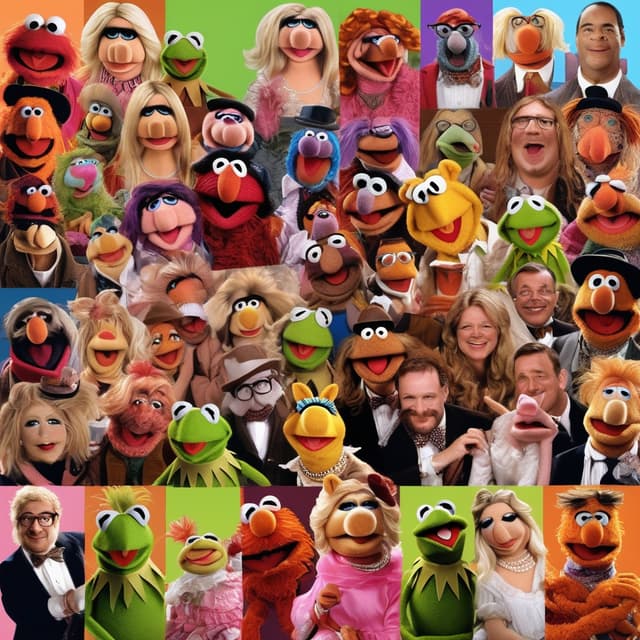
| Type | Avant-garde puppet troupe |
| Formed | 1960s |
| Legacy | Influence felt in alternative and underground media |
| Status | Faded out in 1980s, but influential |
| Purpose | Deliver biting social and political satire |
| Targets | Corporations • Media • Establishment figures |
| Popularity | Cult following, not mainstream |
The Muppets were an American troupe of avant-garde puppets and puppeteers that rose to cult fame in the late 1960s and 1970s for their darkly satirical television shows and specials. In contrast to the lighthearted, family-oriented Muppets franchise in our timeline, this version of the Muppets used their cast of eccentric, expressive characters to deliver biting social and political commentary.
The Muppets were founded in 1964 by a collective of radical puppetry artists, including Tomi Ungerer, Jean-Claude van Itallie, and Ken Nordine. Dissatisfied with the perceived commercialism and conservatism of mainstream children's television, the group sought to create a new kind of puppet show that would satirize American society, politics, and media.
Drawing inspiration from the Bread and Puppet Theater, the Living Theatre and other experimental performance troupes, the Muppets developed a troupe of wildly diverse characters, from the cynical, gravel-voiced Statler and Waldorf to the manic, anarchic Beaker. Instead of pleasant musical numbers and slapstick comedy, their sketches and vignettes often involved social criticism, dark humor, and absurdism.
The Muppets first gained notoriety in the late 1960s for their appearances on underground television and alternative media outlets, where their radical satire found a receptive audience. Sketches might see Kermit the Frog mocking the Vietnam War and the military-industrial complex, Miss Piggy ranting against corporate monopolies, or the Swedish Chef gleefully destroying an McDonald's restaurant.
While generally avoiding overt party politics, the Muppets' overall worldview was decidedly anti-establishment, anarchistic, and left-leaning. Their targets ranged from Richard Nixon and J. Edgar Hoover to the advertising industry and the mainstream media. This incisive, confrontational approach cultivated a loyal following among counterculture and youth culture audiences, but also drew the ire of conservative critics.
Despite their devoted cult following, the Muppets never managed to break into the mainstream television landscape, where their subversive content was deemed too controversial. Occasional Muppet specials and short-lived series were quickly canceled, and the troupe was largely marginalized to local public-access television and college campuses.
However, the Muppets' influence spread through other channels. Their innovative puppetry technique, irreverent humor, and radical politics inspired countless other artists in the alternative comedy, experimental theatre, and underground comics scenes. Numerous Muppet characters and sketches also became cult touchstones, endlessly parodied and referenced by the counterculture.
By the 1980s, many of the Muppets' original founders and puppeteers had aged or passed away. The troupe struggled to find new blood to carry on their legacy, and the Muppets quietly disbanded. Their final television appearance was a 1985 special titled "The Muppets: Tattered and Torn," which reflected on the group's history of struggle and marginalization.
While the mainstream Muppets franchise of our timeline went on to tremendous commercial success, this more subversive version of the Muppets left a more muted but influential legacy. Their revolutionary approach to puppetry and comedy inspired generations of alternative artists, from punk rock bands to avant-garde filmmakers. The Muppets' brand of incisive, counterculture satire can still be felt in the work of contemporary political comedy, experimental animation, and independent media.
